Binder and Inclusions 3D Example
XML Input File
The basename for this file is pbx_3D.xml.
The file can be run using this command:
microstructpy --demo=pbx_3D.xml
The full text of the file is:
<?xml version="1.0" encoding="UTF-8"?>
<input>
    <material>
        <name> Binder </name>
        <material_type> matrix </material_type>
        <fraction> 35 </fraction>
        <shape> sphere </shape>
        <size>
            <dist_type> uniform </dist_type>
            <loc> 0.45 </loc>
            <scale> 0.25 </scale>
        </size>
        <color> lightgray </color>
    </material>

    <material>
        <name> Inclusions </name>
        <material_type> crystalline </material_type>
        <fraction> 65 </fraction>
        <shape> sphere </shape>
        <size>
            <dist_type> lognorm </dist_type>
            <scale> 0.8 </scale>
            <s> 0.3 </s>
        </size>
        <color> darkorange </color>
    </material>

    <domain>
        <shape> cube </shape>
        <side_length> 3 </side_length>
        <corner> (0, 0, 0) </corner>
        <periodic> True </periodic>
    </domain>

    <settings>
        <directory> pbx_3D </directory>
        <verbose> True </verbose>
        <rng_seeds>
            <size> 1 </size>
            <position> 1 </position>
        </rng_seeds>

        <!-- the overlap tolerance: with 0.7 all the seeds can be placed -->
        <rtol> 0.7 </rtol>

        <!-- the seeds and the grains stay a margin away from the periodic
             faces, or cross them by more than the margin: auto is half the
             target edge length, at most an eighth of the smallest grain -->
        <periodic_margin> auto </periodic_margin>
        <edge_opt> True </edge_opt>
        <edge_opt_n_iter> 10 </edge_opt_n_iter>

        <mesh_min_angle> 15 </mesh_min_angle>
        <mesh_max_volume> 0.02 </mesh_max_volume>

        <seeds_kwargs>
            <linewidths> 0.2 </linewidths>
        </seeds_kwargs>
        <poly_kwargs>
            <linewidths> 0.2 </linewidths>
        </poly_kwargs>
        <tri_kwargs>
            <linewidths> 0.1 </linewidths>
        </tri_kwargs>
    </settings>
</input>
Materials
This is the 3D version of the Binder and Inclusions Example: crystalline
inclusions (65% of the volume, spherical seeds with lognormal diameters) in
a binder (a matrix phase, 35% of the volume, seeded with small spheres).
Domain Geometry
The materials fill a cube of side length 3, periodic in the three directions.
Settings
The overlap tolerance rtol is set to 0.7 so that the small binder seeds
can be placed between the inclusions, and the random number generator seeds
make the microstructure repeatable.
The mesh has a minimum dihedral angle of 15 degrees and a maximum element volume of 0.02.
The seeds are placed a margin away from the periodic faces (periodic_margin
set to auto: half the target edge length, or an eighth of the smallest
grain if that is smaller) and the edge optimization moves the seeds that
leave a thin piece of a grain on a face, a corner narrower than the minimum
angle of the mesh, or a very short edge, since any of these forces very
small tetrahedra.
Output Files
The three plots that this file generates are the seeding, the polyhedral mesh, and the tetrahedral mesh. These three plots are shown in Fig. 29 - Fig. 31.

Fig. 29 Binder and inclusions 3D example - seed geometries.
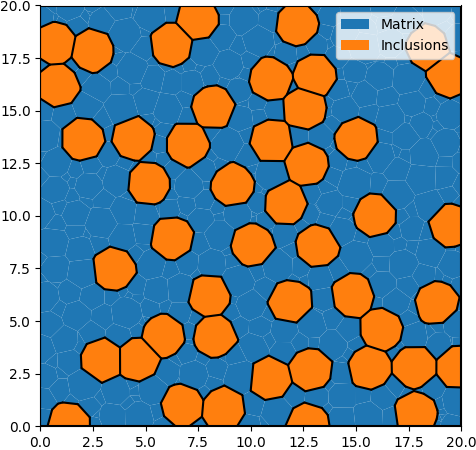
Fig. 30 Binder and inclusions 3D example - polyhedral mesh.
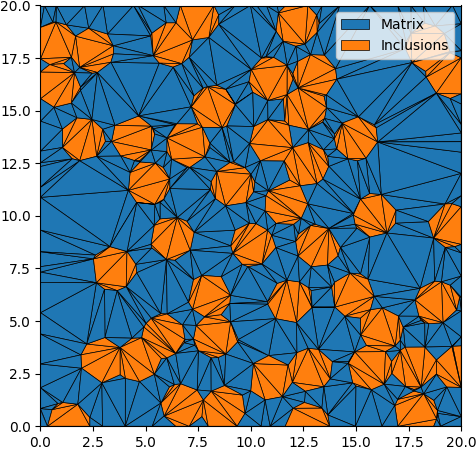
Fig. 31 Binder and inclusions 3D example - tetrahedral mesh.
